Every December 12, millions of pilgrims flood into Mexico City. Some walk for days. Some cross the final mile on their knees. They are all heading to the same place: a hill called Tepeyac, where a poor indigenous man met the Virgin Mary nearly five hundred years ago.
This is the story of Our Lady of Guadalupe — how it happened, what the mysterious image on a cactus-fiber cloak means, and why it still stops skeptics in their tracks today.
The apparitions at Tepeyac
On the morning of December 9, 1531, a 57-year-old widower named Juan Diego was walking to Mass when he heard birdsong unlike anything he had ever known. On the hill of Tepeyac, a woman appeared to him, surrounded by light. She spoke in his native language, Nahuatl, and made a simple request: build a church on this spot, so she could show her love to all the people of this land.
Juan Diego did what any of us would do. He went to the bishop.
Bishop Juan de Zumárraga listened politely — and did not believe him. Who could blame him? The Spanish had conquered Mexico only a decade earlier. The idea that the Mother of God would appear not to a bishop or a nobleman, but to a poor indigenous convert, was almost insulting to the colonial order.
The Virgin appeared to Juan Diego again. And again. Each time, she insisted. Each time, the bishop demanded proof.
The roses, the tilma, and the image
On December 12, Juan Diego’s uncle fell gravely ill, and Juan Diego set out to fetch a priest. Trying to avoid another delay, he took a different route around the hill. The Virgin found him anyway.
She told him his uncle was already healed. Then she gave him the proof the bishop wanted: roses, blooming out of season on the frozen, rocky top of Tepeyac. Juan Diego gathered them in his tilma — a rough cloak woven from cactus fiber — and carried them to the bishop.
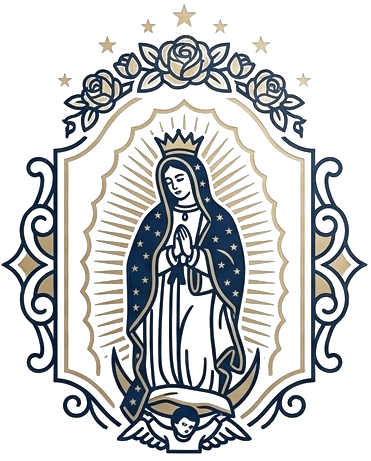
When he opened the tilma and the roses tumbled out, everyone in the room fell silent. On the coarse fabric, where there had been nothing before, stood a perfect image of the Virgin: hands folded in prayer, head bowed, standing on a crescent moon, clothed with the sun.
Bishop Zumárraga sank to his knees. The church was built. And the tilma — made of a fiber that normally decays within 20 years — has survived intact for nearly five centuries.
What the image actually says
To Spanish eyes, the image was beautiful. To the indigenous people of Mexico, it was a text they could read fluently, written in their own visual language:
- She stands in front of the sun — she is greater than the sun god Huitzilopochtli.
- She stands on the moon — she tramples the moon god underfoot.
- Her hands are folded and her head is bowed — she is powerful, but she herself prays to someone greater.
- The black band at her waist — in Aztec custom, this announced that a woman was expecting a child.
- The flower on her tunic — the four-petaled nahui ollin, the Aztec symbol of the divine presence at the center of all things.
- Her skin is mestizo — neither Spanish nor purely indigenous, but a mother for the new people being born between two worlds.
The message landed. Within seven years of the apparition, more than eight million indigenous people asked for baptism — the largest mass conversion in the history of Christianity. Missionaries had struggled for a decade with almost no results. An image did in seven years what sermons could not.
Why skeptics keep failing to explain it
The tilma has been examined by scientists, photographers, and skeptics for centuries. A few puzzles keep coming up:
Cactus-fiber cloth should have crumbled centuries ago. This one hasn’t. The image was not sketched or underdrawn — there is no preliminary drawing underneath it, which is nearly unheard of in 16th-century painting. And when the image is magnified, ophthalmologists have reported reflections in the Virgin’s eyes that match how a real human eye reflects figures standing before it.
In 1921, a bomb hidden in a flower arrangement exploded directly beneath the tilma. The blast twisted a heavy brass crucifix nearby. The glass in front of the image shattered. The tilma itself was untouched.
None of this proves anything, scientifically speaking. But nobody has managed to explain it away, either — and five centuries of trying is a long time.
Why she still matters
In 1945, Pope Pius XII called Our Lady of Guadalupe “Empress of the Americas.” In 2002, Pope John Paul II canonized Juan Diego — the first indigenous saint of the Americas.
But her real title is the one ordinary people gave her: La Virgencita, the little Virgin. The one who shows up for the poor, the overlooked, and the not-quite-believed. The one who chose Juan Diego — a man nobody would have picked — and built the most visited Catholic shrine on earth through him.
Today, the Basilica of Our Lady of Guadalupe receives around 20 million visitors a year, making it the most visited Marian shrine in the world. Her image hangs in living rooms from Los Angeles to Manila, on candles, tattoos, murals, and — yes — on the walls of our own families.
If her story means something to you, you will understand why we built this store. Every design we make honors the original tilma image, and a portion of every order goes back to charitable programs in Mexico — the land where a mother once appeared on a hill and asked, simply, for a place to love her people.