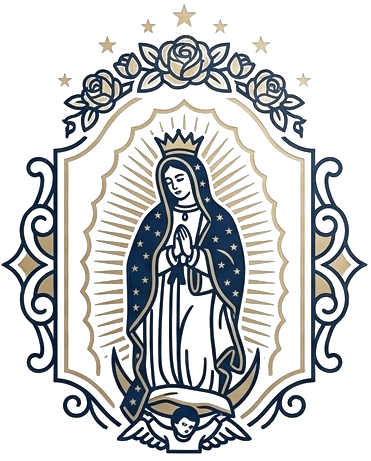
In December 1531, on a bare hill north of Mexico City, the Virgin Mary appeared to a 57-year-old indigenous widower named Juan Diego. Ten years earlier, Spanish conquistadors had toppled the Aztec empire. The old gods were gone, and the new religion arrived with swords. Into that wreckage stepped a woman who spoke Nahuatl, the language of the conquered, and asked for one small thing: a church.
This is the history of Guadalupe the Virgin — what happened, what the image on Juan Diego’s cloak actually says, and why nearly five centuries later it still moves millions of people who have never set foot in Mexico.
Tepeyac: four apparitions in four days
The hill was called Tepeyac. It was not holy ground in 1531 — quite the opposite. It held a shrine to Tonantzin, the Aztec mother goddess, and Spanish authorities were actively suppressing it.
Juan Diego was walking to Mass on the morning of December 9 when he heard what the accounts describe as unearthly birdsong. A young woman appeared and told him, in his own language, that she wanted a temple built there so she could show her mercy to everyone who called on her. He went straight to Bishop Juan de Zumárraga.
The bishop did not believe him. Juan Diego returned to Tepeyac, reported the failure, and was told to try again. He did. Twice more. On the fourth day, the Virgin gave him the proof the bishop demanded.
The roses and the tilma
December 12. Juan Diego’s uncle Juan Bernardino was dying, and Juan Diego set out to find a priest — taking a detour to avoid another encounter. It did not work; she met him anyway, told him his uncle was already cured, and sent him to gather roses blooming on the frozen hilltop. Roses do not bloom in December on that rock.
He carried them in his tilma, a coarse cloak woven from cactus fiber. When he opened it before the bishop, the roses fell out — and on the fabric was an image of the Virgin, hands folded, eyes downcast, standing on a crescent moon with the sun behind her.
The bishop fell to his knees. Within seven years, roughly eight million indigenous people requested baptism. That is the largest mass conversion in Christian history, and it happened after a decade in which missionaries had achieved almost nothing.
Reading the image: a message in two languages
Here is what makes the image so unusual. It worked on two audiences at once, and the indigenous reading was the louder one.
- She stands in front of the sun — greater than Huitzilopochtli, the sun god.
- She stands on the moon — trampling the moon deity.
- The black maternity band at her waist — in Aztec dress, this announced a pregnancy. She carries Christ.
- The four-petaled flower on her tunic — nahui ollin, the Aztec symbol of divine presence at the center of all things.
- Her skin is mestizo — neither Spanish nor purely indigenous. A mother for the people being born between two worlds.
- Her hands folded, head bowed — she is powerful, and she herself prays to someone greater.
To a people who had just lost everything — temples, gods, rulers — this said: the divine has not abandoned you. She speaks your language. She looks like you.
Why the tilma has never been explained away
Cactus-fiber cloth normally disintegrates within about twenty years. This one is approaching five hundred, displayed in the Basilica of Our Lady of Guadalupe, and it has no visible underdrawing or sketch beneath the image — which is nearly unheard of in 16th-century painting.
In 1921, an anarchist hid a bomb in a bouquet of flowers and placed it at the foot of the tilma. The blast twisted a solid brass crucifix standing nearby and shattered the glass protecting the image. The cloth itself was undamaged.
Skeptics have offered natural explanations for centuries. None has been universally accepted, and the image keeps outliving its critics.
Why it still matters now
In 1945, Pius XII named her Empress of the Americas. In 2002, John Paul II canonized Juan Diego, the first indigenous saint of the Americas. Today the Basilica receives around 20 million visitors a year — more than Lourdes and Fatima combined.
But the more telling number is the one you see on the street: on car dashboards, taquería walls, murals in East LA, candle labels, tattoos, and the living rooms of grandmothers who never learned to read. La Virgencita belongs to ordinary people, and always has.
That is why I built this shop. Every piece we make starts from the original tilma image, rendered with modern tools and then refined by hand until it holds the reverence the original deserves. If you would like to bring that image into your own home, our Guadalupe canvas wall art is where I would start.
What the name “Guadalupe” actually means
This is the question people ask most often, and the honest answer is that nobody knows for certain. The most cited explanation is a linguistic one: the Virgin gave her name in Nahuatl, and Spanish ears heard something close to an existing Spanish word. Candidates include Coatlaxopeuh (“she who crushes the serpent”), Tecoatlaxopeuh (“she who banishes those who harmed us”), and Tequantlaxopeuh. Juan Diego’s uncle, Juan Bernardino, reportedly used “Tlecuauhtlacupeuh” when describing her after his cure.
The competing explanation is simpler: Guadalupe is the name of a Marian shrine in Extremadura, Spain, where the Virgin was already venerated, and the Spanish simply reused a familiar name. Both theories have serious defenders. Either way, the name traveled with the image, and today La Virgen de Guadalupe is what most Spanish speakers call her — while English speakers tend to say Our Lady of Guadalupe, and the affectionate form is La Virgencita.
How the devotion reached the United States
The image moved north with the people. Mexican communities in Texas, California, and the Southwest carried it in the 19th and 20th centuries, and the Bracero program and later migration spread it further. By the 1970s, Guadalupe had become the central symbol of the United Farm Workers movement — César Chávez marched under her banner from Delano to Sacramento in 1966, and the image appeared on the walls of labor halls and on the backs of strikers.
Today she is everywhere in American Catholic life: parish murals, quinceañera banners, lowrider hoods, ICU waiting rooms. In 1999, Pope John Paul II named her Patroness of the Americas, and the shrine built in her honor in Wisconsin draws visitors from across the Midwest.
May Our Lady bless your home,
Mateo Alvarez (Founder & Sacred Artist)